The Crew Space of the Cruiser OLYMPIA
Part II
By Patrick
McSherry
Please Visit our Home
Page to learn more about the Spanish American War
As the visitor continues along the crew
area on the Berth Deck, looking overhead, the visitor will see a series
of hooks. These hooks were used by the crew to support their hammocks.
Each crewman was assigned a numbered set of hooks, and only alternating
hooks were used. This allowed each man a space of approximately 32
inches by 96 inches for his hammock to swing. From this close spacing,
it can clearly be seen that the crew accommodations were quite crowded.
Also, in the overhead area can be seen the galley tables, which are
stored on supports in an inverted position from the deck above. The mess
tables present seem to be from the 1902 refit of OLYMPIA,
since they have legs. The original tables used in 1898 were supported by
lines from the overhead. OLYMPIA was the only
ship in the Asiatic squadron that retained her tables after the Battle
of Manila Bay. The commanders of the other vessels in squadron
jettisoned their wood tables, benches, etc. for fear of splinters and
fire that could result in battle. On the flagship, there was apparently
such confidence that there was no order given to throw the tables
overboard. As a result, for several months after the battle, the crew
of the OLYMPIA was the only crew in the Asiatic Squadron that did
not have to eat their meals off the deck. If so, their presence today is
evidence of Commodore Dewey’s decision not to
jettison wooden equipment before the Battle of
Manila Bay.
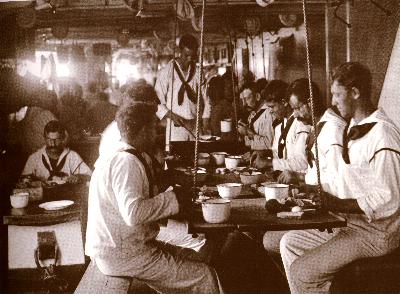
In this original view of the crew on OLYMPIA,
note the tables slung from the overhead, the white enameled
tinwear which had a blue stripe around the rim, and the hats
hanging on the hammock hooks, above. The men appear to be having a
hearty meal of a stew with potatoes, an egg, an apple and a slice of
bread. This would indicate that this mess has a good caterer (the man
designated to purchase supplies for this mess of about 24 men).
This area of the vessel also houses the “scuttlebutt”
or water dispenser. The term “scuttlebutt,” came into being
because of the exchange of news, real or imagined, that occurred when
the men met at the "scuttlebutt." The "scuttlebutt", is approximately
32 inches in diameter and five feet, six inches high. The water in the
“scuttlebutt” was cooled by the vessel’s innovative refrigeration
system.
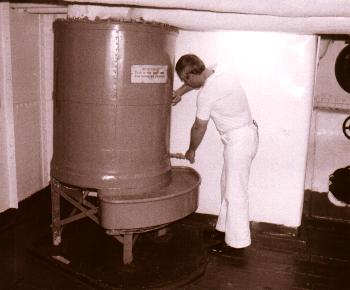
A member of the Living History Crew gets water at
the "scuttlebutt"
Proceed to the Firemens'
Washroom Page
To visit the website bibliography, click here. To visit the website video
bibliography, click here
Support
this
Site by Visiting the Website Store! (help
us defray costs!)
We are providing
the following service for our readers. If you are interested in
books, videos, CD's etc. related to the Spanish American War, simply
type in "Spanish American War" (or whatever you are interested in)
as the keyword and click on "go" to get a list of titles available
through Amazon.com.
Visit Main Page
for copyright data