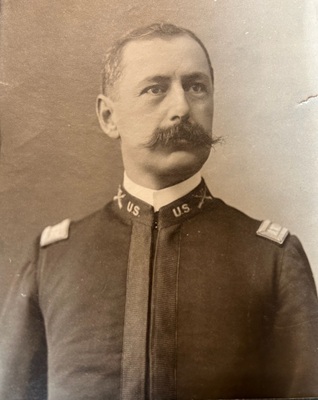
Below is the biography of Charles St. John Chubb of the 17th U.S. Infantry.
The Biography:
Charles St. John Chubb Jr. was born in Washington DC on September 29,
1854 to Charles St. John Chubb Sr., a banking executive, and Eliza Crane
Warrington Chubb, daughter of the highly-decorated and well-respected
U.S. Navy Commodore, Lewis Warrington. The younger Chubb worked as
a bank clerk until October 5, 1873, when he enlisted in the Army at the
age of nineteen . He served as a private in the Adjutant General’s
office working as a clerk, until receiving a commission as 2nd
Lieutenant in 17th U.S Infantry on January 20, 1875. He accepted
the commission and was discharged as a private on the same day:
February 6, 1875. It is unclear how he managed to go from private to 2nd
lieutenant, but it assumed that since the promotion came through the
adjutant general's office, his connections in the office had a hand in
this promotion.
As a newly commissioned officer, Chubb went West. The 17th U.S.
Infantry was stationed at multiple posts in the Dakota Territories in
1873. In this period of history, it was very rare for an entire regiment
to be together in one place. Companies, or at most battalions, generally
served independently. Chubb was assigned to the regiment's Company H at
Camp Hancock, where he was assigned as post quartermaster. He
continued to serve in this capacity on several detached assignments at
various posts in the Territory, including the Standing Rock Reservation,
Fort Yates, and Fort Abraham Lincoln. At the latter post Chubb likely
met the officers and troops of the 7th U.S. Cavalry, including then Lt.
Col. George Custer, Maj. Marcus Reno, Capt. Thomas Custer and
others who would subsequently be lost at the Battle of the Little
Bighorn in 1876.
With the outbreak of the Spanish American War, the 17th U.S. Infantry
departed Columbus, Ohio bound for Tampa, Florida on April 19, 1898. The
regiment entrained onto sleeper cars for its travels through Cincinnati,
Nashville, Birmingham, Thomasville and northern Florida. The
17th arrived in Tampa on April 22, where it marched to Tampa Heights and
set up camp. It would remain at this camp until May 28.
On June 6th, the regiment entrained at West Tampa bound for Port Tampa
where it boarded the transport ships on
June 11. The regiment was placed aboard the transports CHEROKEE,
IROQUOIS and MANTEO
with Company F. being aboard the the latter. The regiment left Tampa Bay
on June 14 and went ashore at Daiquiri, near Santiago on June 22.
Company F was held in support but was not engaged at Las
Guasimas on June 24. The regiment was engaged in a series of
probing marches between June 25 and June 29 On June 30, the
regiment marched to El Caney and
engaged the enemy on the morning of July 1. Over the next
four days, Company F saw heavy combat at in the trenches heights
near near Santiago de Cuba. Combat was not the only cause for
loss, as disease was rampant throughout the regiment during this
time. Over the next month, Company F would lose half its men to
battle casualties, disease and detached service. Of the 67 men in
the company that boarded transports on June 11, only 29 men remained
capable for duty at the end of August. The men of Company F
endured hardship and dire moments in Cuba, under the leadership of
Chubb. After the 17th U.S. Infantry left Cuba, Captain Chubb continued
to lead Company F through a period of recovery at Camp
Wikoff at Montauk Point, Long Island and also at the regimental
Barracks at Columbus, Ohio.
Several accounts indicate that Chubb was especially well-liked and
respected by his men. In his personal account, Company F's First
Sergeant Arron Willard Neyhouse stated: “Charles St. John Chubb
treated me almost as if I were his son.” Another account
comes from an article printed in a Washington DC newspaper. The
article states that on February 4, 1899, the the enlisted men of Company
F called Chubb to the company’s quarters, where they surprised him with
a ceremony of appreciation and an engraved service sword. This was
evidence of the the strong bonds between the enlisted men of Company F
and their captain that were forged during the combat in Cuba. Together,
Chubb and his men would continue experience combat. The ceremony of
appreciation was, coincidentally, held the same day that the
Philippine-American War broke out.
In December, 1898, the 17th U.S. Infantry was ordered to the
Philippines. The regiment's Third battalion, including Company F,
departed the U.S. from New York City on
February 10, 1899. Chubb led his men to action in the
Philippines, where Company F fought at San Fernando,, Cutcut, Candaba,
Angeles, Arayat, Calasiao and Tagaytay, during the months of May through
August, 1899. Captain Chubb continued to lead Company F until
November 4, 1899, when he was appointed to the position of regimental
quartermaster. He continued to serve with the 17th U.S. Infantry
until he was promoted to Major and transferred to the 27th Infantry on
March 21, 1901. By 1907, Charles St, John Chubb was still in the
Philippines, serving as the Lieutenant Colonel of the 2nd U.S. Infantry
at Panang on the island of Mindanao.
Ancestry.com. U.S., Select Military Registers, 1862-1985 [database
on-line]. Lehi, UT, USA: Ancestry.com Operations, Inc., 2013. This
collection was indexed by Ancestry World Archives Project contributors
Army Cemetery Explorer, Arlington National Cemetery, https://www.arlingtoncemetery.mil/Explore/Find-a-Grave, Grave of Charles St. John Chubb
Arron W. Neyhouse’s Account of Serving with the 17th US Infantry, Company F; https://www.spanamwar.com/17thusCoFNeyhouse.html.
Chubb, Capt. C. St. J. Chubb, The 17th Regiment of Infantry: The
Army of the United States, Historical Sketches Of Staff and Line with
Portraits of Generals in Chief, Edited by Theo[Philus] Francis
Rodenbough BVT Brigadier General USA and WIlliam L. Haskin Major First
Artillery (New York: Maynard and Merrill & Co, 1896).
Evening Star (Washington, District of Columbia). February 3,
1899, Page 5
Evening Star (Washington, District of Columbia). April 25, 1913,
Page 5
Findagrave,com Memorial for Charles St. John Chubb, memorial/49166770
The Journal of Charles Taylor, 17th US Infantry Company F - June - July 1898; https:www.spanamwar.com/17thustaylorjournal.htm.
Marriage Announcement, Baltimore Sun. December 3. 1878.
National Archives, U.S., Returns from Military Posts, 1806-1916 - Returns for Fort Abraham Lincoln, April and November, 1875; Standing Rock Reservation, July 1878; Fort Yates, March, 1883; Panang, Mindanao, February, 1907
National Archives and Records Administration (NARA); Washington, D.C.; U.S., Marriage Records, 1810-1953, FHL Roll 002079251
National Archives and Records Administration (NARA); Washington, D.C.; Returns from Regular Army Infantry Regiments, June 1821 - December 1916; Microfilm Serial: M665; Roll: 186
National Archives and Records Administration (NARA); Washington, D.C.; Federal Census for 1900; District 0187, Columbus Barracks, Franklin, Ohio; National Archives and Records Administration
National Archives and Records Administration (NARA); Washington, D.C.;
Consolidated Military File of Charles St. John Chubb; NAID: 7174633 | I
Local ID: 4932-ACP-1874; 9 (Also source for the photo of Capt. Chubb).
Obituary of Charles St. John Chubb, Evening Star. Washington, District of Columbia: Tuesday, April 29, 1913.
Register of Enlistments in the U.S. Army, 1798-1914; Microfilm Publication M233, 81 rolls; NAID: 1184717, 575272 and 1223563; Records of the Adjutant General’s Office, 1780’s-1917, Record Group 94; The National Archives in Washington, D.C.
Federal Census for 1900; District 0187, Columbus Barracks, Franklin, Ohio; National Archives and Records Administration