Corporal Preston Morrow,
of the First Texas Volunteer Infantry
Writes Home about Experiencing Colon Cemetery
Contributed by Alexandra Knowlton
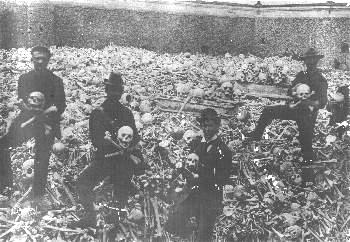
The cemetery of which Cpl. Morrow writes was the Colon
Cemetery in Havana, and was a location of great interest to American
soldiers in Cuba. Above is an admittedly poor photo of the bone yard,
but will give the reader the an impression of the conditions
seen
Please Visit our Home
Page to learn more about the Spanish American War
If you have additional info. on any
member of this regiment, please contact
us
Click here
to read a brief history of the 1st Texas Volunteer Infantry
Click here to read a
letter from Ben C. Love, an officer in the 1st Texas
Click here for a
roster of the 1st Texas Volunteer Infantry
Click here to read a letter from
Irving Poole, of Company K, 1st Texas
General:
Corporal Preston Perry Morrow was born
on April 11, 1875 at Georgetown, Williamson County, Texas. He began his
service as a private in Company A of the First Texas
Volunteer Infantry. He rose in rank to become a corporal
and also served in Company C of the same regiment. Corporal Morrow died
on November 17, 1917 at the young age of 42 years of age. He is buried
in the Magnolia Cemetery in Mobile, Alabama.
The following letter was written by Cpl.
Morrow to his father, Captain Joseph Clay Stiles Morrow, who apparently
released it to the newspaper for general interest. At this time Morrow
and the 1st Texas Volunteer Infantry were serving in the
occupation force in Cuba.
In his letter, Cpl. Morrow discusses
daily activities as well as a visit to the famous "bone yard" in
Havana's famous Colon Cemetery. Americans were unaccustomed to the
practice of plot rent and reuse of graves, so this was a bit shocking.
The sailors killed in the explosion of the battleship
MAINE were also interred, temporarily, in the Colon Cemetery and
were viewed by Cpl. Morrow.
The Letter:
HAVANA’S HUMAN BONEYARD
__________________________
DISINTERRED BODIES TAKEN FROM TENANT GRAVES, THROWN IN A
PIT AND PILED HIGH.
___________________________
PRIMINTIVE MODE OF CREMATION
______________________________
Description of a Trip Through the Dead House – One of the
Greatest Health Menaces.
______________________________
Houston, Tex., Jan. 23. – The following interesting letter from
Preston Morrow of the First Texas regiment
to his father here tells of camp life changes, a Cuban cemetery, a death
house and the graves of the Maine
victims:
Havana, Cuba, Jan. 17. – Captain J. C. S. Morrow, Houston, Tex. – My
Dear Father:
In pursuance of the promise contained in my last letter to yourself to
write to you again at the first opportunity which presented itself, I take
up the pen again this evening to give you a little further insight
into the daily life of a First Texas
infantryman in Cuba.
Since our arrival here we have had no drilling and precious little
work to do. We hear the once hated words, “Fall in!” only three times
per day now, and that is for the roll call at reveille, retreat and
tattoo. Formerly it was the most frequent command heard in camp, and the
poor, harassed soldier boys grew to hate the sound with all the venom
engendered by a long and disagreeable acquaintanceship with it. Now,
however, all is changed, and “Fall in” has become almost a pleasant
sound to our ears, for it is a welcome punctuation to the soldiers daily
existence, where formerly it was the prelude to a long, tiresome drill
in the field movements or an equally unwelcome dress parade.
The principal object of life now is to kill time from reveille until
tape, and with this laudable purpose animating him, you may find the
soldier boy sprawling himself beneath the grateful shade of some banana,
orange or palm tree convenient to camp, with either a Spanish vocabulary
or some writing materials in his hand, and thus dull time wearily drags
its length along.
Saturday morning inspection of arms, equipment etc., come as a not
unwelcome interruption to such an existence of idyllic idleness. Once in
a while the boys vary the monotony by taking a tramp of exploration to
points of interest within a convenient distance of camp, such as nearby
villages, cemeteries and old Spanish fortifications. A short description
of one of these places
which I visited the other day in a spirit of idle curiosity may
interest you a little, and at the same time, give you an idea of some of
the queer places down here that an ennuied man in search of fresh
experiences may bump up against occasionally.
One day last week several of we Emmets concluded it would be too tame
and commonplace to spend the day in camp, so after a short consultation
regarding the place where we had best go we decided to visit the Colon
cemetery, on the outskirts of Havana, wherein we had previously learned
were interred the remains of those who had perished when the Maine was blown up here last February.
After a fatiguing tramp of about four miles across creeks and meadows,
through thickets and hedges rich in briars and brambles, and up and down
the grassy slopes of numerous hills, we at length reached the famous old
cemetery which was named in honor of the world’s most famous navigator –
Christopher Columbus, or Cristobal Colon, as these people call him.
It is a queer institution, this old burying ground of centuries, about
a mile in length and by three-quarters of a mile in width, inclosed with
a wall or fence about fourteen feet in height, with alternate panels,
probably forty feet in length, of thick sculptured stone and heavy
ornamental iron grating. The gates were locked, but that did not deter
us in the slightest, for we soon found a loose iron bar in the wall and
each of us succeeded in squeezing through. Then we started upon our tour
of observation, and it is needless for me to add that we made a very
thorough one before returning to camp late in the afternoon.
Not very far from the place in the wall through which we had gained
admission to the cemetery we found a large pile of skeletons stacked up
beneath a tree, and close to it were a number of workmen engaged in the
pleasant and cheerful occupation of disinterring others and adding to
the collection underneath the tree. Nearby a fire composed of the rotten
coffins, burned sullenly and polluted the atmosphere with the fumes of
its sickening smoke. We silently stood by and watched the workmen labor
at their grewsome task until their shovels brought up to view the livid
and distorted features of a badly decomposed corpse, then we sloped, for
American stomachs can not stand everything with impunity, and we had
seen enough of the exhuming process to satisfy our curiosity, anyway.
We met a citizen before we had gone very far from the trench and fire
and pile of bones, and in reply to questions he stated that burial lots
in the cemetery were so dear that only the wealthy could afford to
purchase them outright; that when a poor man died his friends rented a
grave for him at so much per annum, and that when the rent was left
unpaid for a certain length of time the remains were disinterrered and
thrown upon the bone pile mentioned above and the grave leased to
another occupant.
It seems to me to be a most cruel and monstrous custom to dig up a
dead man’s bones and stock them up under a tree just because his friends
are too poverty stricken to pay the rent on a pitiful two by six plot of
ground.
As I muse thus the thought occurs to me
that man is the only animal who will willingly and intentionally disturb
the dead of his own kind, and that despite his thin veneering of culture
and civilization he is every bit as much a brute at heart as any other
member of God’s animal kingdom.
Near the middle of the cemetery we located
the two humble mounds beneath which repose in their last sleep the
bodies of those who went down with the Maine.
You would not know the graves unless some one kindly pointed them out to
you, as was done in our case. A cheap wooden cross, with a simple
inscription in Spanish painted upon it, is all that has been done to
indicate the place. It is not even protected by a fence. No tablet of
bronze or shaft of sculptural marble marks the sacred spot where heroes
sleep. No flowers have been placed upon it by loving hands to impress
upon the wandering stranger its sanctity. Only the rich tropical grass,
in seeming atonement for man’s neglect, is sending its green tendrils
over the mounds in an effort to conceal from view the unsightly clods of
rough brown earth beneath their tender caress.
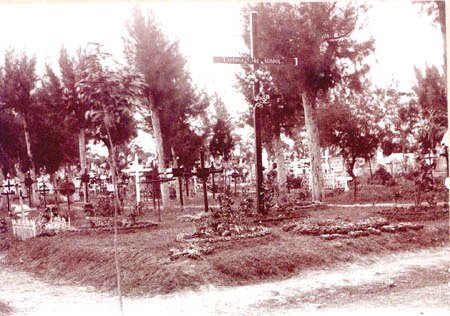
The graves of the sailors killed in
the explosion of the battleship MAINE. The
photo was taken soon after the funeral. Presumably the large woodne
corss shown in the one seen by Morrow and his compatriots. The sailors
interred here were eventually disinterred and returned to the United
States
Just across the driveway from the Maine’s plot stands its direct
antithesis in point of beauty – the monument erected at a cost of
$250,000 by Havana citizens to commemorate the death of thirty local
firemen who lost their lives in an explosion here in 1890. It is a
magnificent specimen of the sculptor’s skill. Chiseled in Paris of
purest Italian marble it is indeed a beautiful creation of art. The top
of the monument, which is about forty feet in height, is surmounted by a
statuary of a heroic size, representing an angel bearing heavenward in
her arms the body of a dead fireman. On the four corners of the pedestal
recline life-sized figures of different angels. The sides of the
pedestal are ornamented with bas-relief busts of the dead firemen with
their names over each. Midway of the shaft are carved the municipal arms
of Havana, the arms of Cuba Español, the insignia of a soldier and the
apparatus pertaining to an engine company. The base of the monument is
covered with the appropriate inscriptions eulogizing the dead and
setting forth the incidents connected with the disaster. Altogether the
monument is the most beautiful one many of we boys have ever seen
After leaving the monument we decided to
visit the casa del muerte, or dead house, connected with the cemetery,
before returning to camp. This is located at the southern gate. Our
curiosity prompted us to learn the manner in which Havana disposes of
its pauper dead, which in recent years have been very numerous. An
obliging cemetery employe whom we met at the gate, in reply to our
questions concerning the dead house, kindly volunteered to pilot us to
and through it. Through a long, low, rambling stone building filled with
a numerous assortment of rooms – for the house is inhabited by the many
cemetery employes as well as by Havana's dead paupers – some of the
rooms were used as kitchens, dining rooms, bed rooms, parlors, offices,
storage rooms for the effects of the unknown dead or coffins for the
reception of the wealthy and more aristocratic who die in their own
beds, stables for horses, granaries, buggy and hearse rooms, the entire
heterogeneous collection massed beneath a common roof.
Our guide led us to the grated door of the
casa del muerta and politely motioned us to enter. We did so, and in
awed manner looked around upon the scene of death. Along the center of a
low room, twenty feet wide by fifty long, were standing a row of heavy
tables, with two or three long, shallow, narrow, cove?lea? Oaken boxes
resting upon each, and in these boxes lay the remains of human beings
like ourselves, whose breasts were once sentient with the throbbings of
health and hope. Although as naked as when they came into the world, you
could see nothing of the dead save their head, hands and feet; all other
portions of the frame were concealed beneath thick little heaps of
quicklime, for this is the local mode of practising cremation. The casas
del muerte is both a morgue and a crematory, and the reason why the
faces of the dead are left uncovered by the chemical so long is because
the authorities hope that someone will come forward to identify the
remains of the unknown before the final process is adopted, and also
because the head and feet yield more quickly to the corrosive effect of
the chemical than any other portion of the frame.
If no one claims the corpse within a
certain length of time quicklime is heaped upon the head, feet and
hands, and after its disintegrating work has been completed the skeleton
is then removed from the house and thrown into a deep pit close by in
the cemetery to keep company with thousands of others which have
preceded it. Some of the cadavers were almost destroyed, in others the
process was only half completed, while others still were evidently new
arrivals, for the quicklime heaped upon them was pure and white, as
though it had just been placed there, as was evidently the case.
Lying in one corner of the room in all
positions, where they had been unceremoniously dumped out of a dead
wagon a few minutes previous to our arrival, were the remains of five or
six paupers found around the city that morning. They were still covered
by the rags in which they had died, and were awaiting the process of
cremation.
When our eyes had taken in all the room
and its lugubrious details, we decided to return to camp, for we had
seen enough horrors for the time being. In years to come even the sight
of an innocent lime barrel will be sufficient to conjure up to our minds
the vision of the horrors we witnessed during our visit to the casa del
muerte of Colon cemetery.
Uncle Sam has a stupendous task before him
in regenerating the government of this island, for besides
indoctrinating these people with the principles of political economy and
local self-government, he must also teach them a regard for the laws of
sanitation and hygiene. I do not wonder that Havana is the birthplace of
plagues and pestilences, for as long as Colon cemetery with its pit, its
bone-pile, its sullen fire built of rotten coffins, its exhumed corpses
and its dead-house, with the primitive mode of cremation practised
therein, just so long will the health of the city be under dire menace.
In my next letter I shall try and tell you
of some of the fortifications around here and of the labyrinth of
passages which exists beneath old For Principe near the city. Several of
us intend visiting it within the next few days.
Well, I must close for the time being, but
will write again soon.
If I can obtain some plates for my Kodak
down in the city I will send you some photos of Cuban sights and scenes
in my next letter.
With best regards to all my friends in
Houston I remain, affectionately,
PRESTON MORROW.
Bibliography:
Find-a-Grave listing for Preston Poole Morrow, memorial #91311947.
Knowlton, Alexandra - The letter of Cpl. Preston Morrow quoted above.
U.S., Spanish American War Volunteers Index to Compiled Military
Service Records, 1898 (listing for Preston Perry Morrow).
Support this
Site by Visiting the Website Store! (help
us defray costs!)
We are providing
the following service for our readers. If you are interested in
books, videos, CD's etc. related to the Spanish American War, simply
type in "Spanish American War" (or whatever you are interested in)
as the keyword and click on "go" to get a list of titles available
through Amazon.com.
Visit Main Page
for copyright data