Lee United States Navy Rifle, Model
1895
By Patrick McSherry
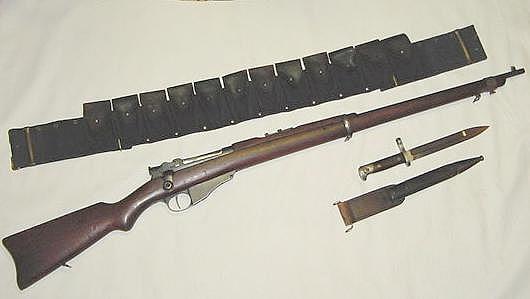
This image shows the Model 1895 Lee Rifle, with its
ammunition belt and bayonet with scabbard
(photo courtesy of the Doug Howser Collection)
Please Visit our Home
Page to learn more about the Spanish American War
Click here
for an article concerning the qualities of the Lee Rifle from the
period of the war
Read about the effects of gunfire by clicking
here
GENERAL:
This rifle was designed by James Paris Lee, "one of the foremost arms
inventors of the century". It was a standard U.S. Navy weapon in the
Spanish-American War era.
BACKGROUND:
The Lee rifle was accepted by the Navy in 1895 and manufactured by
Winchester beginning in 1896, with an initial order of ten thousand units.
Eventually close to twenty thousand were produced. A large number of these
weapons were aboard the USS MAINE when it sunk in
Havana Harbor. Fifty of these were later recovered and sold. The Lee was
considered to be ahead of its time, and was not well-liked outside of the
U.S. Navy. Production stopped in 1902.
The Lee has what is frequently referred to as a straight-pull action.
In fact, the action is more properly a camming action in which pulling
the bolt caused a the bolt to rock, freeing a stud from the receiver and
unlocking the bolt. The cartridge used by the weapon was the smallest
cartridge adopted by the U.S. military up to that time.
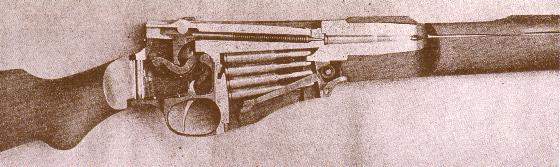
Acut-away view of the mechanism
ADVANTAGES/DISADVANTAGES:
The weapon, unlike the Krag-Jorgensen Rifle of
the time period, was not designed for the ammunition in the magazine to be
held in reserve for emergencies while the weapon itself was basically used
as a single shot rifle. The magazine could be reloaded very quickly,
allowing the "ammunition reserve" to be unnecessary.
The ammunition used for the Lee utilized smokeless powder, offering a
definite advantage over the "trapdoor" rifle.
Shell casings were automatically extracted from the weapon. The
extractor, however, had a tendency to fall out in battle, and if not
carefully replaced, would render the rifle non-functional.
One disadvantage of the weapon was that, when the magazine still had
ammunition in it, the gun could not be used for firing single shots. A
second problem was severe erosion of the bore because of the powder used
in the weapon's cartridges.
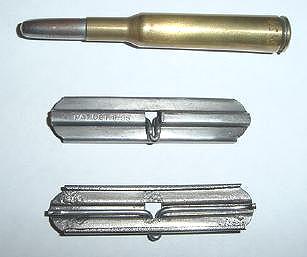
Lee 6mm cartridge with five round charger
TECHNOTES:
| Action: |
|
Straight pull bolt
action rapid-fire breech-loader |
| Total length: |
|
47.75 inches |
| Length of barrel: |
|
28 inches |
| Rifling: |
|
6 grooves, making one turn in 6.5 inches. |
| Weight: |
|
8.32 pounds |
| Ammunition: |
|
6mm rimless, in five round clips |
| Charge: |
|
33 grains of smokeless powder |
| Weight of cartridge: |
|
332 grains |
| Weight of projectile: |
|
135 grains |
| Muzzle Velocity: |
|
2,460 feet per second at 60 feet from the
muzzle. This gave the |
|
|
weapon the ability to penetrate 3/8 inch steel
boiler plate at 100 feet. |
| Bayonet: |
|
Knife-type, 8.25" long |
Alger, Prof. P. R. USN, and Ensign N. C. Twining, USN, The United
States Navy Rifle, U.S. Bureau of Ordnance.
Gluckman, Arcadi, United States Muskets, Rifles and Carbines.
Buffalo: Otto Ulbrich Co., Inc., 1948.
Howser, Doug (Image of rifle with belt and bayonet, and image of
ammunition).
Kirkland, K. D., America's Premier Gunmakers: Winchester, New
York: Exeter Books, 1989.
New York Sun, June 1898.
Schreier, Philip, "The Guns of the Spanish American War," Military
Classics Illustrated (Los Angeles: Emap USA, 2001).
Support this Site by
Visiting the Website Store! (help us
defray costs!)
We are providing
the following service for our readers. If you are interested in
books, videos, CD's etc. related to the Spanish American War, simply
type in "Spanish American War" (or whatever you are interested in)
as the keyword and click on "go" to get a list of titles available
through Amazon.com.
Visit Main Page
for copyright data